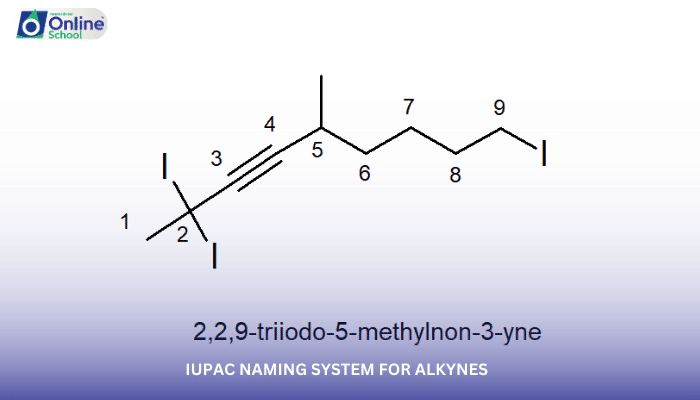
Learning Outcomes:
i. Understand the basic principles of the IUPAC nomenclature system for alkynes.
ii. Identify the parent chain in an alkyne molecule based on the longest carbon chain containing the triple bond.
iii. Locate the position of the triple bond and assign a locant number to indicate its position.
iv. Name substituent groups attached to the main carbon chain using prefixes and numerical locants.
v. Apply the IUPAC naming system to correctly name various alkyne structures, including branched and cyclic alkynes.
Introduction:
Alkynes, a class of unsaturated hydrocarbons, contain at least one triple bond (≡) between carbon atoms. The IUPAC naming system provides a systematic method for naming alkynes, ensuring consistent and unambiguous identification of these compounds. This lesson delves into the IUPAC naming system for alkynes, guiding students through the rules and conventions for naming these unsaturated hydrocarbons.
i. Identifying the Parent Chain:
Longest Carbon Chain: The parent chain is the longest continuous chain of carbon atoms that includes the triple bond.
Prefixes based on Chain Length: The parent chain determines the root name of the alkyne using the following prefixes:
- Eth- (2 carbons)
- Prop- (3 carbons)
- But- (4 carbons)
- Pent- (5 carbons)
- Hex- (6 carbons)
- Continued with -ene (7 carbons onward)
ii. Locating the Triple Bond:
Locant Number: The position of the triple bond is indicated by a locant number, which is placed before the parent chain name.
Numbering Priority: Number the carbon atoms in the parent chain so that the triple bond receives the lowest possible combination of locant numbers.
Multiple Triple Bonds: If multiple triple bonds are present, use locant numbers to specify the positions of each triple bond.
iii. Naming Substituents:
Prefixes for Substituents: Substituent groups attached to the parent chain are named using prefixes, such as:
- Methyl- (CH3-)
- Ethyl- (CH3CH2-)
- Propyl- (CH3CH2CH2-)
Locants for Substituents: Assign locant numbers to the carbon atoms attached to the parent chain to indicate the position of substituents.
Multiple Substituents: When multiple substituents are present, list them in alphabetical order, followed by the parent chain name.
Duplicate Substituents: If multiple identical substituents are present, use prefixes like di-, tri-, tetra-, etc., to indicate the number of substituents.
iv. Naming Branched Alkynes:
Identify Branch Chains: Identify branch chains, which are shorter chains attached to the main chain.
Numbering Branches: Number the carbon atoms in each branch chain independently, starting from the point of attachment to the main chain.
Naming Branches: Use locant numbers to specify the attachment point of each branch and include the branch chain name in parentheses before the parent chain name.
v. Naming Cyclic Alkynes:
Cyclical Prefix: For cyclic alkynes, replace the -ane suffix with the prefix -yne.
Numbering Cyclic Alkynes: Number the carbon atoms in the cyclic chain, starting from the triple bond and assigning the lowest possible combination of locants.
Naming Substituents: Name substituents using locant numbers, similar to acyclic alkynes.
The IUPAC naming system for alkynes provides a structured and consistent approach to naming these unsaturated hydrocarbons. By mastering the rules and conventions of this system, chemists can effectively communicate the identity of alkynes, enabling accurate identification and understanding of these compounds in various chemical contexts.
